
Table of Contents
Introduction to Forearm Workouts
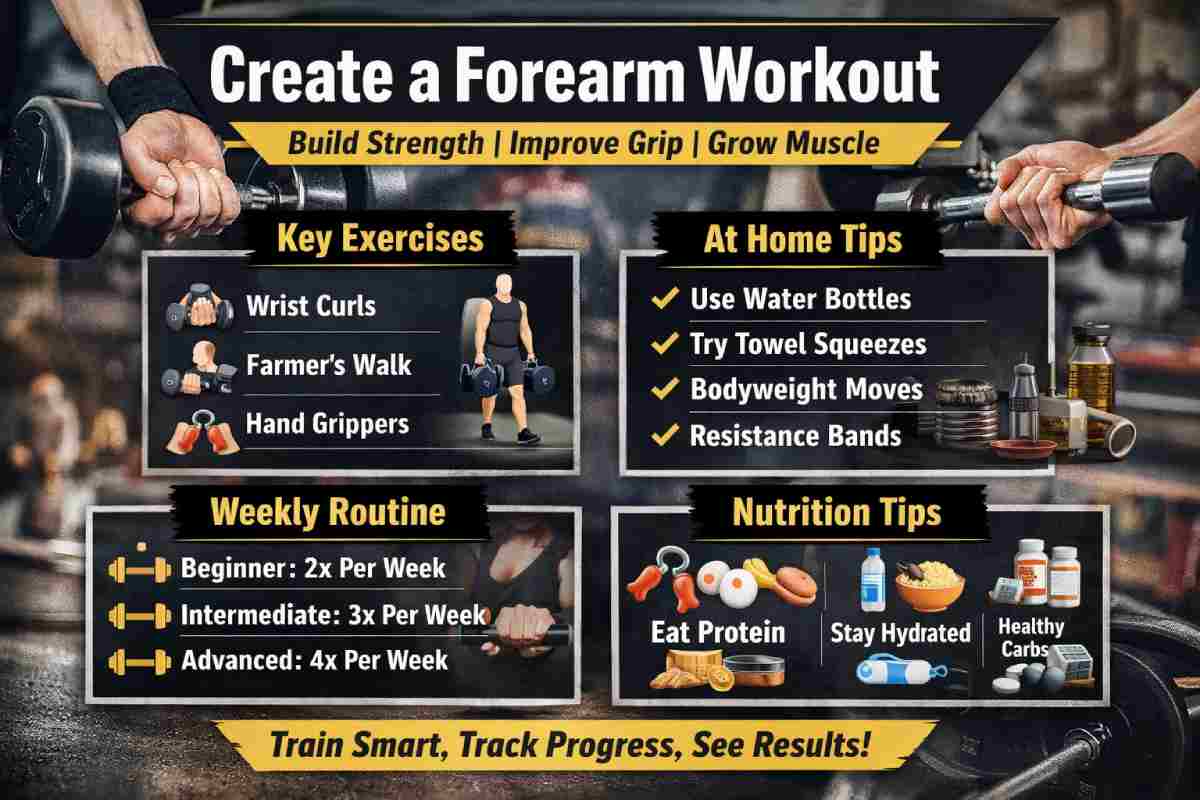
Forearm workouts are a critical yet often overlooked part of fitness routines. While many people focus on larger muscle groups like the chest, back, and legs, the forearms play an important role in grip strength, daily functionality, and athletic performance.
The forearm contains muscles between the elbow and wrist that help control hand and finger movement. These muscles are used in everyday activities such as lifting groceries, typing, carrying objects, and opening jars. Improving forearm strength can enhance grip ability and support functional physical performance.
Forearm exercises can also complement broader strength-training routines. For people who enjoy going to the gym, incorporating targeted forearm exercises alongside compound movements can contribute to a more balanced workout program. You can learn more about the benefits of going to the gym as part of an overall fitness routine.
Anatomy of the Forearm Muscles
Understanding forearm anatomy helps you target different muscles and movement patterns during strength training.
| Muscle Group | Location | Function | Importance |
|---|---|---|---|
| Flexor Muscles | Inner forearm | Wrist and finger flexion | Grip strength |
| Extensor Muscles | Outer forearm | Wrist extension | Balance & stability |
| Brachioradialis | Upper forearm | Elbow flexion | Strength support |
| Pronators/Supinators | Deep forearm | Rotation of wrist | Functional movement |
The forearm contains numerous muscles that work together to control wrist, hand, and finger movement.
Benefits of Forearm Workouts
Forearm training offers multiple benefits beyond aesthetics.
| Benefit | Explanation | Relevance |
|---|---|---|
| Improved Grip Strength | Helps hold and lift objects | Useful for daily tasks |
| Better Athletic Performance | Supports sports such as baseball and tennis | Useful for athletes |
| Injury Management | Supports wrist and forearm strength | Helps build physical resilience |
| Functional Strength | Supports daily activities | Improves physical function |
| Muscle Balance | Complements upper-body training | Supports balanced development |
Grip strength is also associated with measures of physical function and health, particularly in older adults. However, grip strength alone should not be treated as a diagnosis or complete measure of overall health.
Grip Strength Data
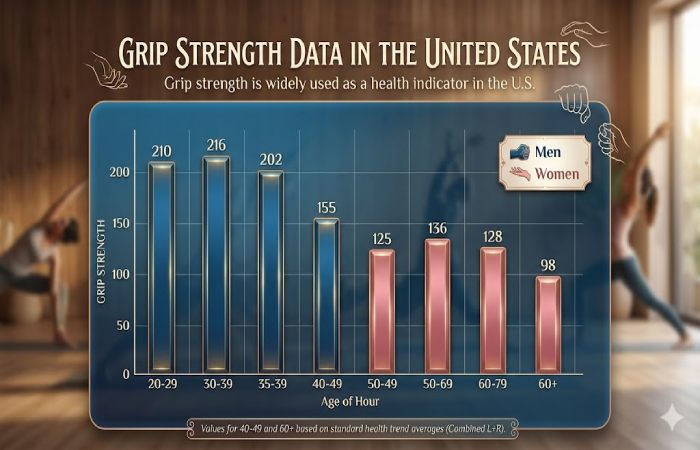
Grip strength is commonly used in fitness and clinical research as one measure of physical function.
| Age Group | General Trend |
|---|---|
| 20–29 | Generally high strength |
| 30–39 | Often near peak adult strength |
| 40–49 | Gradual changes may begin |
| 60+ | Strength commonly declines with age |
- Grip strength varies substantially based on age, sex, body size, training history, and measurement method.
- Maintaining muscle strength and physical activity becomes increasingly important with age.
Best Forearm Workouts for Beginners
Beginners should start with simple, controlled movements and gradually increase resistance as their strength improves.
| Exercise | Equipment | Reps | Benefits |
|---|---|---|---|
| Wrist Curls | Dumbbells | 10–15 | Builds flexors |
| Reverse Wrist Curls | Dumbbells | 10–15 | Targets extensors |
| Farmer’s Carry | Dumbbells | 20–30 sec | Improves grip |
| Hand Grippers | Tool | 10–20 | Strengthens grip |
These exercises can be performed at home or in a gym and can be adjusted according to your fitness level.
Advanced Forearm Exercises for Growth
Once your basic strength improves, more challenging exercises can be introduced to increase strength and muscular development.
| Exercise | Difficulty | Target Area | Key Benefit |
|---|---|---|---|
| Dead Hangs | High | Grip & endurance | Builds grip strength |
| Plate Pinches | High | Thumb strength | Improves pinch grip |
| Towel Pull-Ups | High | Full forearm | Challenges grip |
| Zottman Curls | Medium | Forearm & biceps | Supports muscle growth |
These exercises can complement a broader strength-training program. They should be progressed gradually, particularly when they place significant stress on the wrists, elbows, or fingers.
Forearm Workouts at Home (No Equipment)
Home workouts are popular because they are convenient and require little equipment.
| Exercise | Method | Benefit |
|---|---|---|
| Towel Squeeze | Twist towel | Grip strength |
| Fingertip Push-Ups | Bodyweight | Finger strength |
| Wrist Rotations | Mobility | Wrist movement |
| Water Bottle Curls | Household item | Beginner-friendly |
Bodyweight exercises can also be useful for people who prefer training without traditional gym equipment. Self-loading exercises use body weight as resistance and can be adapted to different fitness levels.
Gym-Based Forearm Workout Routine
Gym training allows you to gradually increase resistance and track your progress.
| Exercise | Sets | Reps | Equipment |
|---|---|---|---|
| Barbell Wrist Curl | 3 | 10–15 | Barbell |
| Reverse Curl | 3 | 8–12 | Barbell |
| Cable Wrist Curl | 3 | 12–15 | Cable machine |
| Hammer Curl | 3 | 10–12 | Dumbbells |
You can adjust the number of sets and repetitions based on your training experience and overall workout program.
Weekly Forearm Workout Plan
Strength training is generally recommended as part of a balanced physical activity routine. The appropriate frequency for direct forearm training depends on the exercises used, overall training volume, and recovery.
| Level | Frequency | Routine |
|---|---|---|
| Beginner | 1–2x/week | Basic wrist curls |
| Intermediate | 2–3x/week | Add carries & hangs |
| Advanced | 2–3x/week | Heavier grip work |
You do not necessarily need to train the forearms every day. They are also involved indirectly in exercises such as rows, pull-ups, deadlifts, and carries.
Nutrition for Forearm Muscle Growth
Nutrition plays an important role in muscle development and recovery.
| Nutrient | General Role | Sources |
|---|---|---|
| Protein | Muscle repair and growth | Chicken, eggs, dairy, legumes |
| Carbohydrates | Exercise energy | Rice, oats, potatoes, fruits |
| Healthy Fats | Supports overall nutrition | Avocado, nuts, seeds |
| Hydration | Supports normal physical function | Water and other fluids |
Protein needs vary according to body size, activity level, age, and individual goals. A balanced diet is generally more important than focusing on a single nutrient.
Common Mistakes to Avoid
| Mistake | Impact | Solution |
|---|---|---|
| Overtraining | Muscle fatigue | Allow recovery |
| Heavy weights | Increased injury risk | Start gradually |
| Poor form | Reduced effectiveness | Focus on technique |
| Ignoring warm-up | Reduced preparation | Do wrist mobility |
Because the wrists and forearms are involved in many upper-body exercises, excessive direct training can contribute to fatigue or overuse problems.
Forearm Workouts for Specific Goals
| Goal | Recommended Exercises |
|---|---|
| Strength | Dead hangs, carries |
| Muscle Size | Wrist curls, Zottman curls |
| Endurance | Higher-repetition exercises |
| Sports Performance | Functional grip training |
Forearm strength can be useful in sports such as baseball, basketball, tennis, climbing, and other activities that require grip or wrist control.
Forearm Workouts for Athletes
Athletes often rely on grip and forearm strength as part of their sport-specific training.
| Sport | Potential Benefit |
|---|---|
| Baseball | Better bat control |
| Basketball | Ball handling |
| Football | Grip strength |
| Tennis | Racket control |
Sport-specific training should also include movements and conditioning appropriate to the demands of the individual sport.
Safety Tips and Injury Prevention
| Tip | Explanation |
|---|---|
| Warm up | Prepares the body for exercise |
| Move wrists through a comfortable range | Supports mobility |
| Use proper form | Helps reduce unnecessary strain |
| Rest days | Allows recovery |
Proper training technique and gradual progression can help reduce the risk of overuse and training-related injuries. Stop an exercise if you experience sharp pain, significant swelling, numbness, or other unusual symptoms and seek appropriate medical advice when necessary.
Equipment for Forearm Workouts
| Equipment | Use |
|---|---|
| Dumbbells | Wrist curls |
| Barbells | Heavy lifting |
| Grip trainers | Hand strength |
| Resistance bands | Resistance and mobility exercises |
Equipment for Forearm Workouts With Prices & Where to Buy
| Equipment | Example Product | Use | Price (Approx.) | Where to Buy |
|---|---|---|---|---|
| Dumbbells | Slovic Dumbbells Set for Home Gym 5 Kg | Wrist curls, hammer curls | ₹1,500 – ₹5,000 | Amazon, Flipkart |
| Barbells | Protoner Steel Weight Package | Heavy lifting, reverse curls | ₹1,500 – ₹8,000+ | Amazon, Decathlon |
| Grip Trainers | ComfortFriends Adjustable Hand Gripper | Hand & finger strength | ₹100 – ₹600 | Amazon, Flipkart |
| Resistance Bands | Wiselife Resistance Power Band | Resistance and endurance training | ₹200 – ₹1,000 | Flipkart, Amazon |
Prices can change based on the retailer, product specifications, and promotions. Compare specifications and reviews before purchasing fitness equipment.
Tracking Progress and Results
| Metric | Method |
|---|---|
| Grip strength | Hand dynamometer |
| Muscle growth | Measurements |
| Performance | Exercise reps |
| Endurance | Hold time |
Tracking your workouts can help you identify gradual improvements and adjust your training program when necessary.
FAQs About Forearm Workouts
How long does it take to see results?
The time required to see noticeable changes varies from person to person. With consistent training, adequate nutrition, and recovery, strength improvements may occur within several weeks, while visible muscle growth can take longer.
Can you train forearms every day?
It is generally not necessary to train the forearms directly every day. Because the forearms are involved in many other exercises, allowing recovery between demanding sessions can help manage fatigue and reduce the risk of overuse.
Are forearms hard to grow?
Forearm development varies between individuals. Genetics, training history, exercise selection, nutrition, and recovery all influence muscle growth. Progressive resistance training and consistency are important factors.
Conclusion
Forearm workouts are useful for building grip strength, functional fitness, and overall upper-body performance. Incorporating forearm exercises into a balanced strength-training routine can support everyday activities and athletic performance.
By combining appropriate exercises, nutrition, progressive training, and adequate recovery, you can gradually build stronger forearms and improve your overall fitness. For people who enjoy trying different approaches to exercise, exploring different workout trends can also provide ideas for keeping a fitness routine varied and engaging.