
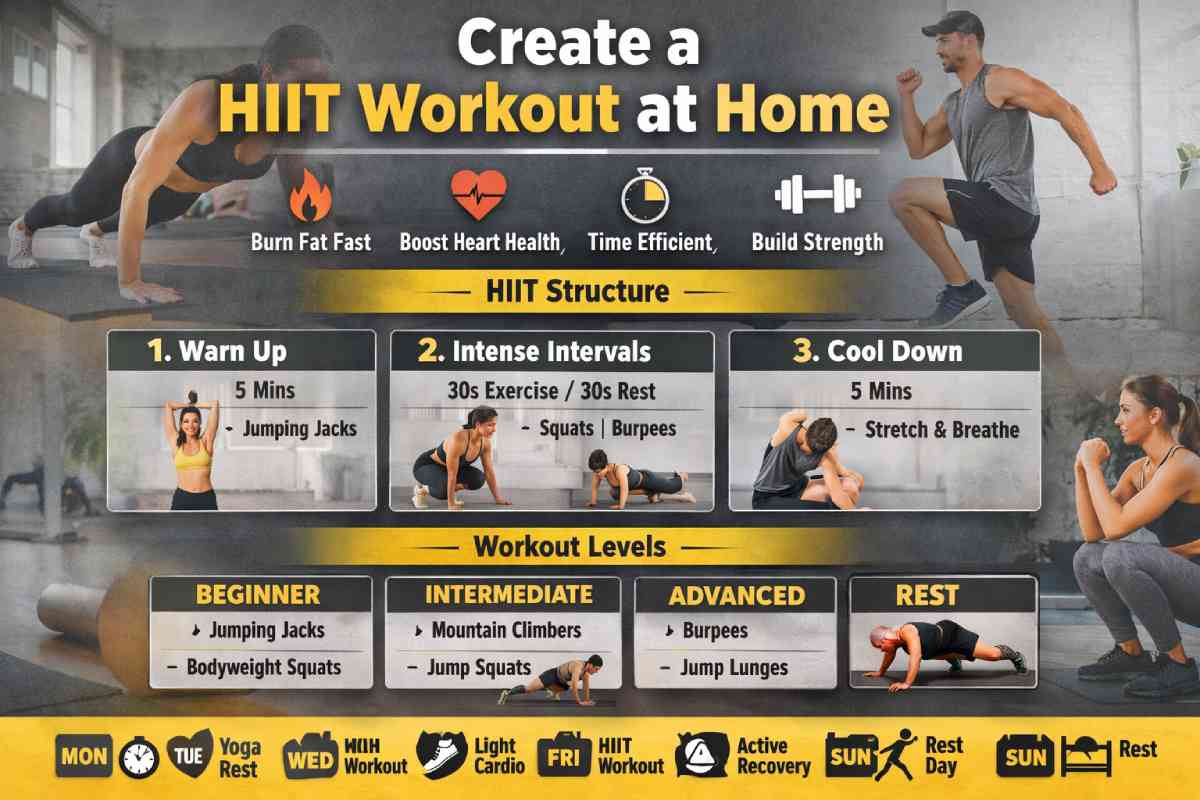
High-Intensity Interval Training (HIIT) has become one of the most effective and popular fitness methods worldwide—especially for people who want fast results without going to the gym. A HIIT workout at home combines short bursts of intense exercise with brief rest periods, making it perfect for busy lifestyles and limited space.
This comprehensive guide explores everything you need to know about HIIT at home, including benefits, routines, schedules, and practical tips—structured in 50% detailed paragraphs and 50% tables for clarity and usability.
Table of Contents
What is HIIT Workout at Home?
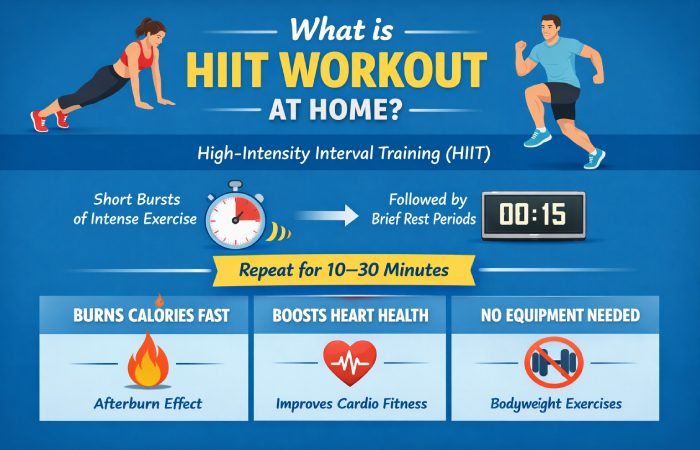
HIIT (High-Intensity Interval Training) is a training technique where you perform exercises at maximum effort for a short period, followed by recovery intervals. These cycles are repeated for 10–30 minutes, delivering powerful fitness results in less time.
Unlike traditional workouts, HIIT focuses on intensity rather than duration. Research shows that even short sessions (10–30 minutes) can significantly improve cardiovascular health, metabolism, and fat loss.
HIIT workouts are especially suitable for home environments because they require minimal or no equipment. Exercises like squats, push-ups, burpees, and jumping jacks can be done anywhere.
Benefits of HIIT Workout at Home
HIIT offers a wide range of physical and mental health benefits. It is considered one of the most efficient workout methods available today.
Key Benefits Explained
HIIT workouts are known for their ability to burn calories quickly. The high intensity pushes your body to work harder, resulting in increased calorie burn even after the workout ends—this is called the afterburn effect (EPOC).
Another major benefit is improved cardiovascular health. Regular HIIT sessions strengthen the heart, enhance blood circulation, and improve oxygen usage efficiency.
HIIT also boosts metabolism and helps in fat loss while preserving lean muscle mass. This makes it ideal for weight management and body toning.
Additionally, HIIT is extremely time-efficient. Studies suggest that even short workouts can produce noticeable improvements in strength, endurance, and mental well-being.
Benefits Table
| Benefit | Description | Scientific Insight |
|---|---|---|
| Fat Burning | Burns calories rapidly | Afterburn effect increases calorie burn post-workout |
| Time Efficiency | Workouts in 10–30 minutes | Short sessions provide similar benefits to longer workouts |
| Heart Health | Improves cardiovascular fitness | Enhances oxygen flow and endurance |
| Muscle Tone | Builds lean muscle | Combines cardio + resistance |
| Metabolism Boost | Increases calorie burn all day | Improves metabolic rate |
| Flexibility | Can be done anywhere | No equipment required |
HIIT Workout Structure at Home
A proper HIIT workout includes three main phases: warm-up, high-intensity intervals, and cool-down.
Explanation
A typical HIIT session starts with a warm-up to prepare the body and prevent injuries. This is followed by intense exercises performed for 20–45 seconds, with rest intervals of 10–30 seconds. The session ends with stretching and recovery.
The key is to give maximum effort during work intervals and allow partial recovery during rest periods.
Basic HIIT Structure Table
| Phase | Duration | Example Activities |
|---|---|---|
| Warm-up | 5 minutes | Jumping jacks, jogging |
| Work Interval | 20–40 sec | Burpees, squats |
| Rest Interval | 10–30 sec | Standing rest, slow walk |
| Rounds | 3–5 cycles | Full-body circuit |
| Cool-down | 5 minutes | Stretching, breathing |
Beginner HIIT Workout at Home
If you’re new to HIIT, start with simple exercises and moderate intensity.
Beginner Routine Explanation
Beginners should focus on proper form rather than speed. Start with lower intensity (70–80%) and gradually increase over time.
Beginner Workout Table (20 Minutes)
| Exercise | Work Time | Rest Time |
|---|---|---|
| Jumping Jacks | 30 sec | 30 sec |
| Bodyweight Squats | 30 sec | 30 sec |
| Push-ups | 30 sec | 30 sec |
| High Knees | 30 sec | 30 sec |
| Plank | 30 sec | 30 sec |
Repeat: 3–4 rounds
Intermediate HIIT Workout at Home
Once your fitness improves, increase intensity and complexity.
Intermediate Routine Explanation
At this stage, include explosive movements like jump squats and mountain climbers. These exercises engage multiple muscle groups and improve endurance.
Intermediate Workout Table
| Exercise | Work | Rest |
|---|---|---|
| Jump Squats | 40 sec | 20 sec |
| Mountain Climbers | 40 sec | 20 sec |
| Push-up Shoulder Taps | 40 sec | 20 sec |
| Lunges | 40 sec | 20 sec |
| Plank Jacks | 40 sec | 20 sec |
Repeat: 4 rounds
Advanced HIIT Workout at Home
Advanced HIIT pushes your body to maximum effort.
Advanced Routine Explanation
Advanced workouts focus on explosive power, speed, and endurance. These sessions are intense and should only be done after building a solid fitness base.
Advanced Workout Table
| Exercise | Work | Rest |
|---|---|---|
| Burpees | 45 sec | 15 sec |
| Jump Lunges | 45 sec | 15 sec |
| Pike Push-ups | 45 sec | 15 sec |
| Sprint in Place | 45 sec | 15 sec |
| Plank to Push-up | 45 sec | 15 sec |
Repeat: 4–5 rounds
Weekly HIIT Schedule
Consistency is key, but overtraining should be avoided.
Explanation
Experts recommend doing HIIT 2–3 times per week with rest days in between to allow muscle recovery and prevent injury.
Weekly Plan Table
| Day | Activity |
|---|---|
| Monday | HIIT Workout |
| Tuesday | Light Cardio / Yoga |
| Wednesday | HIIT Workout |
| Thursday | Rest |
| Friday | HIIT Workout |
| Saturday | Active Recovery |
| Sunday | Rest |
Equipment vs No Equipment HIIT
HIIT can be done with or without equipment.
Comparison Table
| Type | Equipment Needed | Examples |
|---|---|---|
| No Equipment | None | Squats, push-ups |
| Minimal Equipment | Dumbbells | Weighted lunges |
| Advanced | Kettlebells | Swings, snatches |
Common Mistakes in HIIT
Explanation
Many beginners make the mistake of going too hard too soon or skipping warm-ups. This increases the risk of injury and burnout.
Mistakes Table
| Mistake | Problem | Solution |
|---|---|---|
| Skipping Warm-up | Injury risk | Always warm up |
| Overtraining | Fatigue | Limit to 2–3 sessions/week |
| Poor Form | Ineffective workout | Focus on technique |
| No Rest | Muscle strain | Include recovery days |
Safety Tips for HIIT at Home
Explanation
HIIT is safe when performed correctly, but it requires attention to form, intensity, and recovery.
Safety Table
| Tip | Reason |
|---|---|
| Stay Hydrated | Prevent fatigue |
| Maintain Form | Avoid injury |
| Start Slow | Build endurance |
| Listen to Body | Prevent overtraining |
HIIT Workout vs Traditional Cardio
Comparison Table
| Factor | HIIT | Traditional Cardio |
|---|---|---|
| Time Required | 10–30 min | 30–60 min |
| Calorie Burn | High | Moderate |
| Intensity | Very High | Low–Moderate |
| Fat Loss | Faster | Slower |
| Convenience | High (home-friendly) | Requires equipment sometimes |
Final Thoughts
A HIIT workout at home is one of the most powerful and efficient ways to improve fitness, lose weight, and boost overall health without needing a gym. Its flexibility, time efficiency, and effectiveness make it ideal for beginners and advanced users alike.
By following structured routines, maintaining proper form, and allowing adequate recovery, you can achieve impressive results in a short period. Whether your goal is fat loss, muscle toning, or improved endurance, HIIT provides a scalable and sustainable solution.